Not every difficult interaction calls for confrontation. Not every disagreement needs to be resolved. And not every irritating person needs to be removed from your life.
Sometimes the person is family. Sometimes they're a coworker, client, neighbor, friend, community member or someone you regularly encounter. You may still need—or choose—to stay in the relationship, meeting, event or room.
The useful question becomes less How do I make this person different? and more How do I participate deliberately when friction keeps showing up?
Start by identifying the size of the problem
One reason difficult interactions become exhausting is that ordinary irritation, recurring patterns, intrusion and genuine limits can start to feel like the same category. They aren't.
The Tolerance Method™ begins with a simple distinction:
This matters because a Rub doesn't need a Red-Line response, and a Red Line shouldn't be treated like a Rub. The goal is to match the response to the actual problem rather than automatically escalating—or automatically enduring.
Stop treating every disagreement as unfinished business
Some disagreements require a decision. Others can remain unresolved without remaining active. If two people never agree, but nothing practical depends on agreement, continuing to reopen the issue can consume time and attention without changing the outcome.
A useful boundary question is: If they never agree with me, what actually changes? That separates information or decisions that genuinely matter from the desire to be understood, validated or proven right.
When you have to stay in the room, redirect
A redirect isn't a better argument. It's a decision to stop feeding the same conversation.
That is especially useful when you are staying in the relationship, meeting, event, call or room, but you are no longer willing to keep following the conversation wherever it wants to go.
Pass, Turn, Park or Close
PASS declines the invitation to engage. TURN shifts toward another subject, task or person. PARK acknowledges the topic without continuing it now. CLOSE ends your participation in the interaction.
These aren't escalation levels. The useful move is the one that fits the room.
Use fewer words when pushback starts
The first sentence often isn't the hardest part. The harder moment comes when someone pushes back and you feel the urge to add reasons, evidence and explanation.
The Second-Sentence Rule™ takes the opposite approach: your second sentence should contain less new information than your first. Instead of expanding the argument, you shrink it. If necessary, you repeat the same information rather than supplying fresh material for another round.
This is particularly relevant in workplaces and structured settings where the goal may be to return to the task at hand rather than win a personal disagreement.
Account for the cost before and after the interaction
The length of a meeting or conversation doesn't necessarily tell you what it cost. Some interactions begin consuming capacity before they happen through anticipation, then continue afterward through replay.
The Tolerance Reserve™ looks at that capacity directly. The Reserve Gauge™ uses four states—OPEN, NARROW, THIN and EMPTY—as a pre-interaction capacity check, not as a personality score. The purpose is to make a more deliberate decision about what you can reasonably give before someone else effectively spends that capacity for you.
That can lead to more choices than simply enduring or cutting someone off: shorten the interaction, narrow its scope, build in a buffer, pair it with something restorative, defer it, or decline when appropriate.
Turn recurring situations into preparation
If the same situation keeps happening, you shouldn't have to invent a new strategy every time.
A “room” can be literal or figurative: a holiday table, an office, a monthly meeting, a recurring phone call, a visit, a one-on-one obligation or a relationship dynamic that reliably follows the same pattern.
The Situation Playbook™ turns experience into preparation by asking what happens before the room, in the room, at your exit, and after. Instead of improvising under pressure, you can identify the hooks that usually pull you off plan, decide what your actual job is in the situation, choose your redirect language, plan around capacity and determine where the interaction stops following you home.
Where this can be useful
The underlying framework is not limited to a particular age, gender or life stage. Difficult interactions and recurring friction show up in families, friendships, workplaces, community settings, coaching conversations and organizational life.
For an individual, that may mean preparing for a difficult family gathering or recurring conversation. In a professional setting, the same concepts can help someone think more deliberately about a recurring meeting, task-focused redirect, capacity, or a situation that tends to pull attention away from the work at hand.
For coaches, facilitators and organizations, the methodology also points toward potential training applications around communication, boundaries, recurring friction and preparation. Organizational or trainer use would require appropriate licensing rather than redistribution of the individual-use workbooks.
The four-part Tolerance Method Program™
Foundation → Redirect → Reserve → Playbook.
The Tolerance Foundation helps identify what kind of friction is actually happening and where participation changes. The Redirect Scripts provides language for the moments themselves. The Tolerance Reserve addresses what contact costs and what capacity is available. The Situation Playbook brings those pieces together for the rooms that keep coming back.
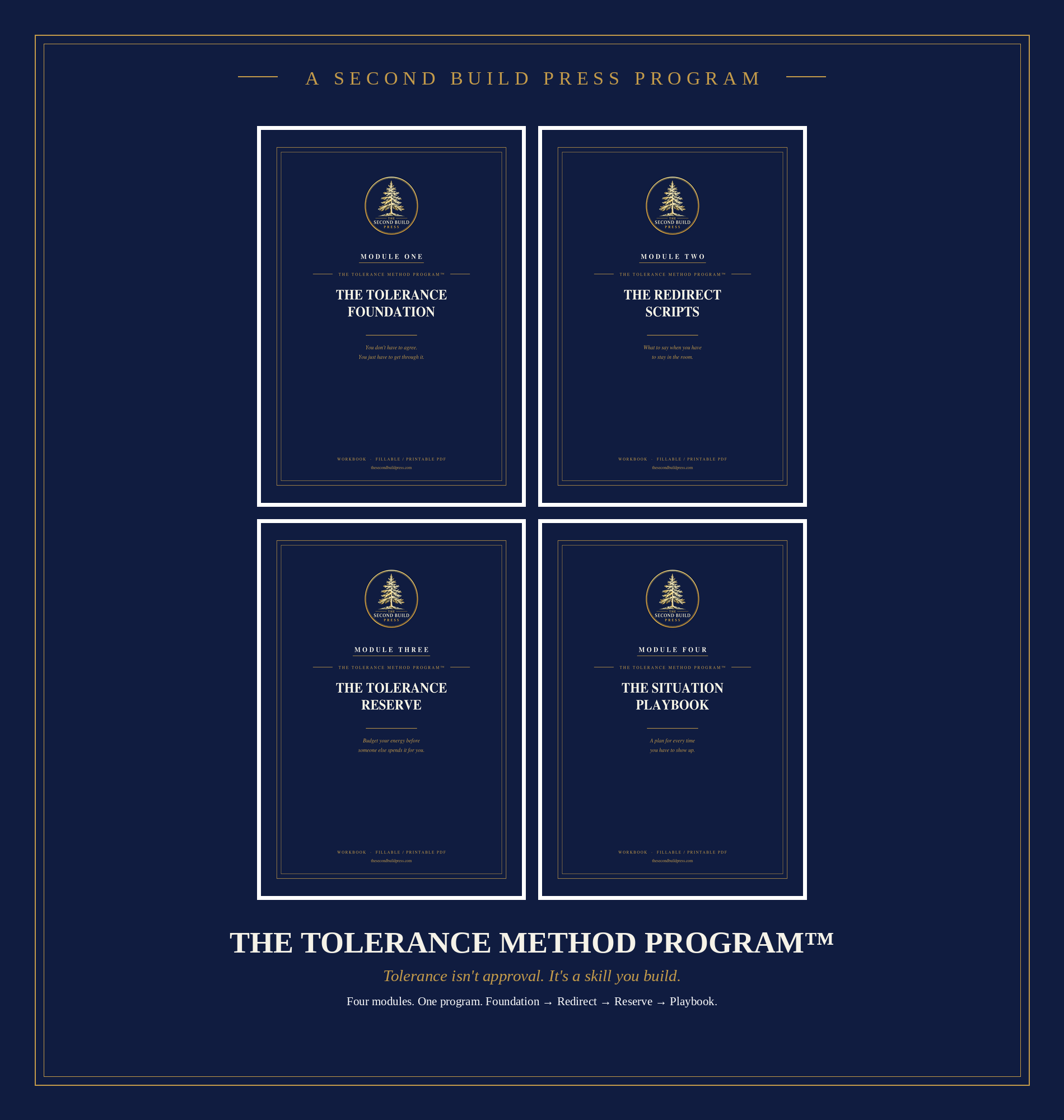
Each module can stand on its own, but the four are designed to work together as one practical system.
The Tolerance Foundation
Identify the kind of friction you’re dealing with and match the response to the actual problem.
The Redirect Scripts
Use practical language to stop feeding conversations you no longer want to keep following.
The Tolerance Reserve
Account for capacity, carryover and what recurring contact actually costs.
The Situation Playbook
Turn repeated situations into preparation instead of improvising under pressure.
Important: The current consumer workbooks are for personal, individual use. They are not medical, mental-health, legal, workplace-compliance or safety advice, and they are not intended for unsafe, abusive, threatening, coercive, harassing, violent or discriminatory situations. Corporate, coaching, facilitation or training use should be handled through separate permission or licensing.